Eyelash Extensions Camberwell: After a Break-up or During an Emotional Period

Break-ups can rearrange ordinary life in ways that have very little to do with beauty. Sleep changes. Routines disappear. Someone who used to organise weekends around another person suddenly has different time, different habits and, sometimes, a rather different idea of who they are. Research on romantic separation has found that break-ups can disrupt self-concept as well as mood, particularly when a person's sense of identity had become closely intertwined with the relationship. At Lena Utmost Beauty, we occasionally see something much smaller taking place inside that much larger experience. A client returns to something she used to enjoy. For one of our clients from Camberwell, that happened through eyelash extensions. She had stopped having her lashes done for several months. After a difficult break-up, she eventually decided to return. During the appointment she spoke openly about what she had been going through and said that getting her lashes done again was one of the things that made her feel more like herself. There was another, rather practical question in the background. She had also been crying. Would that ruin the extensions? Interestingly, despite the emotional period she was moving through, her retention remained quite good. She later acknowledged that she had cried after having them done, but she had also been careful about how she treated the lashes. That experience brings together two questions we have explored separately before. Can beauty routines have psychological meaning during a difficult period? And can crying interfere with eyelash extension retention? The answers to both require more nuance than either beauty marketing or aftercare folklore usually allows.
Why Can a Break-up Affect More Than Mood?
A romantic relationship can become incorporated into everyday identity. Couples develop shared routines, friendships, places, plans and habits. Research by Slotter and colleagues found that romantic break-ups were associated with changes in the content and clarity of people's self-concepts. Reduced self-concept clarity was also associated with greater emotional distress after separation. Other work following people after a break-up found that poorer recovery of self-concept was associated with poorer psychological wellbeing over time. A recent systematic review of 47 studies reached a similarly complicated conclusion. Romantic break-ups can produce both negative and positive psychosocial changes, while adjustment differs considerably between individuals. This helps explain why apparently ordinary routines can acquire unusual significance after a relationship ends.
Someone may return to the gym.
Someone may start seeing friends more regularly.
Someone may change their hair.
Someone may return to the lash appointment she used to enjoy every fortnight.
None of those activities treats the break-up.
But they can become part of reconstructing ordinary life.
Can Eyelash Extensions Help Someone Feel More Like Herself?
For some people, apparently yes. That statement should not be confused with saying that eyelash extensions improve mental health. Research specifically examining eyelash extensions and post-break-up adjustment does not exist. There is, however, evidence that appearance modification can affect certain aspects of self-perception. An experimental study of professional makeup found increases in appearance satisfaction and some dimensions of self-evaluation, including confidence. Interestingly, even the expectation and process of having makeup applied influenced some self-perceptions. Another large international survey of aesthetic-treatment users found that many participants understood aesthetic practices not only in terms of appearance, but also as part of self-care and the relationship between internal identity and outward appearance. As a survey, it tells us about reported attitudes rather than proving psychological benefit, but the pattern is nevertheless relevant. Eyelash extensions are obviously not identical to makeup or medical aesthetic treatments. The useful connection is more modest. Changing or restoring an aspect of appearance can sometimes influence how someone perceives herself. That seems close to what our Camberwell client was describing.
Was It Really the Eyelash Extensions Helping Her?
We cannot know. And that uncertainty matters. She may have liked what she saw in the mirror. She may have enjoyed returning to an old routine. The appointment may have represented a small decision made entirely for herself after months dominated by relationship difficulties. She may simply have enjoyed spending some time outside the circumstances surrounding the break-up. All of those possibilities can coexist. It would be intellectually lazy to attribute the whole experience to eyelashes. But it would be equally dismissive to say that an activity cannot matter simply because it is cosmetic. Human beings attach meaning to routines. Beauty can be part of that, without needing to become therapy.
What Does Psychology Tell Us About Returning to Enjoyable Activities?
Psychological research gives us one useful framework, although it should be handled carefully. Behavioural activation is an evidence-based psychological treatment that encourages increased engagement with meaningful or rewarding activities. A large 2026 systematic review and meta-analysis covering 105 trials found behavioural activation effective for adult depression, although outcomes varied across studies and the intervention is considerably more structured than simply telling someone to “do something nice”. Earlier research similarly described activity scheduling as deliberately increasing pleasant activities and positive interactions with one's environment. A lash appointment is not behavioural activation therapy. A lash artist is not delivering psychological treatment. But this literature does help explain why counsellors and psychologists sometimes encourage people going through difficult periods to continue engaging with activities they value rather than withdrawing from everything enjoyable. For one person, that may involve walking. For another, music. For another, seeing friends. And for someone else, a regular beauty appointment may be one small part of that wider pattern.
Can Beauty Become Too Important After a Break-up?
It can. There is a difference between enjoying your appearance and depending upon appearance to repair your entire sense of self. Research on makeup use shows that cosmetic behaviour is not psychologically uniform. Different patterns of self-esteem and body image can relate to makeup use in different ways. Some people use appearance enhancement confidently, while others may be more concerned with concealing perceived imperfections. That means there is no universal story in which beauty automatically produces confidence. After a break-up, someone may genuinely enjoy experimenting with appearance. Another person may become increasingly preoccupied with whether she is attractive enough, comparing herself with a former partner's new relationship or interpreting the separation through appearance. Those are very different experiences. At Lena Utmost Beauty, we would never tell someone that changing her lashes will fix what happened in her relationship. Sometimes a good set of lashes is simply a good set of lashes. That is enough.
What About Crying?
This is where the emotional and practical parts of the story meet. Our Camberwell client acknowledged that she had cried after her lash appointment. The extensions nevertheless retained quite well. That does not mean crying is irrelevant. Nor does it mean tears inevitably destroy lash adhesive. The effect depends partly on timing and partly on what happens while someone is crying. If a set has only just been applied, we take a conservative approach to prolonged moisture exposure during the early curing period. Different professional adhesive systems have different characteristics, so there is no scientifically established universal number of hours that applies identically to every adhesive. Once the adhesive is fully cured, occasional emotional tears are a different matter. The more significant retention problem may often be what someone does with the eyes during and after crying.
Why Does Rubbing Matter So Much?
Crying is rarely just tears. People rub their eyes. They press tissues against the eyelids. They wipe sideways across the lash line. They may bury their face into a pillow or towel. Research measuring eye rubbing has found that people can apply substantial mechanical force to the eyelids during ordinary rubbing behaviour. The study did not involve eyelash extensions, so it cannot tell us exactly how many extensions someone will lose. But it establishes that rubbing creates meaningful physical forces around the eye. For extensions bonded individually to natural lashes, repeated rubbing or catching can place stress on both the artificial extension and the natural lash. This may explain why two people can cry after an appointment and experience completely different retention. One cries, gently blots her tears and later cleans the lashes normally. Another repeatedly rubs across the lash line. The word “crying” describes both situations, but the mechanical environment is very different.
Does the Composition of Tears Matter?
Possibly, although we should resist turning an interesting biochemical question into an unsupported retention claim. Human tears contain proteins, lipids, electrolytes and metabolites rather than simply water. Research comparing emotional tears with other types of tears has found differences in their biochemical composition. That does not establish that emotional tears have some special ability to break down eyelash adhesive. No good eyelash-specific study has demonstrated that. For retention, the combination of prolonged moisture, residue and mechanical handling remains the more practical concern.
So How Did Our Camberwell Client Keep Good Retention?
We cannot prove why her retention remained good. That is important because individual client stories are observations, not experiments. But her aftercare gave the set reasonable conditions. She did not treat crying as permission to scrub the eye area. She continued cleaning the lashes. She avoided deliberately pulling or picking at them. Even during an emotionally difficult period, she remained fairly conscious of the fact that the extensions were attached to individual natural lashes. That is probably a more useful lesson than telling clients simply, “Do not cry.” Nobody gets to schedule grief around their infill appointment.
Should You Avoid Eyelash Extensions During a Break-up?
Not automatically. If having your lashes done is something you genuinely enjoy and you feel comfortable attending the appointment, a difficult emotional period does not itself make you unsuitable for eyelash extensions. You may need to think a little more consciously about aftercare if you know you are crying frequently. If your eyes are significantly swollen, irritated or uncomfortable from prolonged crying, however, postponing an appointment may be more sensible until the eye area settles. The lash technician should also be told if the eyes are unusually sensitive on the day. That is not a judgement about the emotional situation. It is simply practical treatment planning.
Should You Tell Your Lash Artist That You Have Been Crying?
You do not owe your lash technician the details of your private life. But if your eyes have been watering heavily, rubbing has increased or the eyelids are irritated, telling us about those physical circumstances can help. The explanation can be as simple as saying that your eyes have been watery lately. That gives us information relevant to the treatment without requiring you to discuss anything you would rather keep private. Some clients talk during lash appointments. Others sleep through almost the entire treatment. Both are perfectly acceptable.
What If Your Retention Becomes Worse During an Emotional Period?
Do not immediately conclude that your hormones or emotions have destroyed the adhesive. Look first at the practical changes surrounding the period.
Have you been rubbing more?
Have you been sleeping differently?
Are you cleaning the extensions less consistently?
Have you been crying frequently and wiping the eyes with tissues or towels?
Has your normal skincare or makeup routine changed?
Those questions give us something concrete to investigate. Emotional distress can change behaviour in numerous ways, but a change in retention does not tell us which pathway is responsible.
Can Eyelash Extensions Improve Confidence After a Break-up?
They may improve how some people feel about their appearance. That is different from repairing confidence in the broader psychological sense. The experimental cosmetics literature suggests that appearance modification can influence appearance satisfaction and specific aspects of self-evaluation. But confidence after the end of a significant relationship is shaped by much more than appearance. Identity, attachment, social support, grief, self-concept and the circumstances of the break-up all matter. Research on romantic separation strongly supports the importance of self-concept recovery in post-break-up adjustment. A beauty appointment can sit somewhere inside that much larger process. It should never be mistaken for the process itself.
What If the Emotional Period Is Becoming Overwhelming?
Then eyelashes become a very small issue. Persistent severe distress, inability to function normally, significant anxiety, depression, thoughts of self-harm or other serious psychological symptoms deserve appropriate professional support. There is no contradiction between seeing a psychologist or counsellor and also enjoying beauty treatments. But the treatment should remain what it is. Eyelash extensions can be enjoyable. They can restore a familiar routine. They may change how someone feels about her appearance. They are not mental health care. Maintaining that boundary protects clients from the sort of beauty marketing that tries to turn mascara-adjacent activities into medicine.
Returning to Yourself Can Mean Different Things
The most interesting part of our Camberwell client's story was not that eyelashes somehow defeated heartbreak. They did not. The interesting part was that she eventually returned to something she had stopped doing. Months after the break-up, she came back for her lashes and described the appointment as one small way of beginning to feel like herself again. She still cried sometimes. She still had difficult moments. Her extensions survived those moments reasonably well because she treated them carefully rather than expecting life to become emotionally sterile for the sake of retention. That seems a much more realistic relationship between beauty and everyday life. Beauty treatments should fit within people's lives. People should not have to manufacture perfect lives to accommodate beauty treatments.
Eyelash Extensions for Camberwell Clients at Lena Utmost Beauty
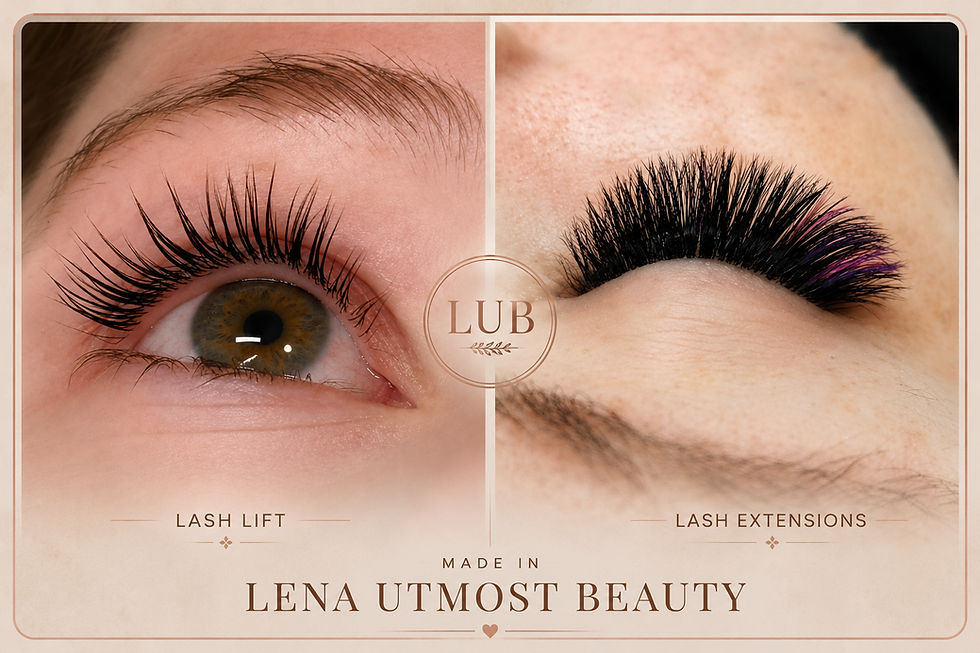
Clients searching for eyelash extensions in Camberwell regularly visit Lena Utmost Beauty in nearby Balwyn for full sets and infills. Eyelash extensions have been one of our specialist services since Lena Utmost Beauty began in 2016. We offer Classic, Light Volume, Natural Volume, Volume/Hybrid Glamour, Mega Volume and Creative Effects, with each set designed according to the client's natural lashes, preferred appearance and lifestyle. If you are returning to eyelash extensions after a break, tell us what you used to wear and what you would like now. You do not need to recreate your old set simply because it is familiar. Some clients return wanting something softer. Others decide they finally want the fuller set they had been considering for years. The consultation should reflect where you are now. Lena Utmost Beauty has received more than 220 Google reviews while maintaining a 5.0-star rating across our beauty services. If you are searching for lash extensions Camberwell or an eyelash salon near Camberwell, you can view our Eyelash Extensions services and booking options and choose the style that suits you.
Frequently Asked Questions
Can I get eyelash extensions after a break-up?
Yes. A break-up itself does not make you unsuitable for eyelash extensions. If your eyes are irritated or swollen from frequent crying, it may be better to wait until the eye area is comfortable before having a fresh set applied.
Can crying ruin my eyelash extensions?
Crying can contribute to poorer retention, particularly with a fresh set or when it involves repeated rubbing and wiping. Occasional tears after the adhesive has fully cured do not necessarily mean the extensions will fall out.
Can eyelash extensions make me feel better after a break-up?
Some people report feeling more confident or more like themselves after beauty treatments. Research on appearance modification suggests that cosmetic changes can influence some aspects of self-perception, but eyelash extensions are not a treatment for emotional distress.
Why might returning to my beauty routine feel important?
Break-ups can disrupt routines and self-concept. Research has found that recovery of self-concept is associated with psychological adjustment after romantic separation. A familiar beauty routine may be one personally meaningful activity within that broader process, but its significance will differ between individuals.
What should I do if I cry after my lash appointment?
Avoid vigorous rubbing or dragging tissues across the extensions. Gently blot tears around the eyes and follow the cleansing instructions provided for your particular adhesive system.
Should I remove my eyelash extensions if I am crying frequently?
Not necessarily. If the lashes remain comfortable and your eyes are healthy, careful cleansing and reduced rubbing may be sufficient. Significant redness, swelling, pain, discharge or other eye symptoms should be assessed appropriately.
Can I return to lashes after taking several months off?
Yes. Your natural lashes and preferences can be reassessed when you return. A new consultation is useful if you want to change length, curl, volume or overall style.
References
Boelen, P. A., & Reijntjes, A. (2009). Negative cognitions in emotional problems following romantic relationship break-ups. Stress and Health, 25(1), 11–19.
Cuijpers, P., Ciharova, M., Tong, L., Liu, Y., Sprenger, A. A., Miguel, C., Karyotaki, E., & Harrer, M. (2026). Behavioral activation for depression: A comprehensive systematic review and meta-analysis. Clinical Psychology Review, 128, 102783.
Cuijpers, P., van Straten, A., & Warmerdam, L. (2007). Behavioral activation treatments of depression: A meta-analysis. Clinical Psychology Review, 27(3), 318–326.
Mason, A. E., Law, R. W., Bryan, A. E. B., Portley, R. M., & Sbarra, D. A. (2012). Facing a breakup: Electromyographic responses moderate self-concept recovery following a romantic separation. Personal Relationships, 19(3), 551–568.
Slotter, E. B., Gardner, W. L., & Finkel, E. J. (2010). Who am I without you? The influence of romantic breakup on the self-concept. Personality and Social Psychology Bulletin, 36(2), 147–160.
Batres, C., Kramer, S. S., DeAngelis, C. G., & Russell, R. (2021). Makeup and its application simulation affect women's self-perceptions. Archives of Sexual Behavior.
Carrillo, S., et al. (2025). Psychosocial effects of romantic breakups during emerging adulthood: A systematic review.


Comments